

The True Cost of Downtime
Feb 6, 2026
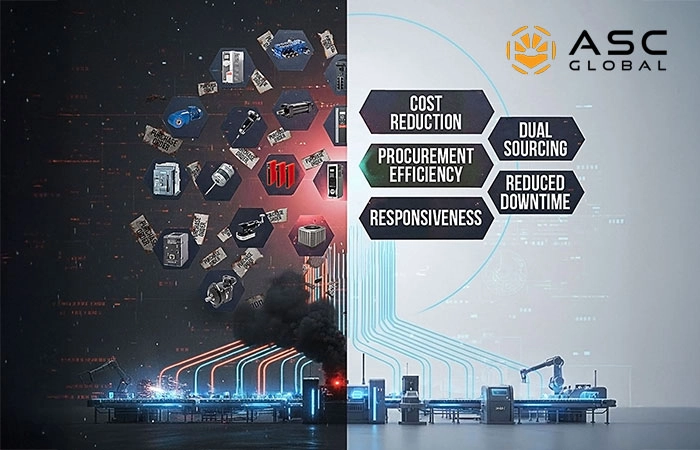
Unplanned downtime is now one of the biggest financial threats to manufacturers worldwide.
Every hour of halted production costs far more than five years ago, driven by rising energy prices, complex supply chains, and interconnected operations.
For the world’s 500 largest companies, downtime now totals $1.4 trillion annually 11% of revenues.
Why Downtime Costs Are Rising Faster Than Inflation
- Energy crisis & price spikes: Global energy costs rose sharply after 2021 and spiked again in 2022 following geopolitical uncertainty, driving up operating costs.
- Complex supply chains: Modern manufacturing networks are highly interdependent; a halt in one area triggers delays across the line, amplifying losses.
- Inflation vs downtime costs: US inflation (2019–2023) = 19%; cost of an hour’s downtime rose 113% in Automotive and 319% in Heavy Industry.
Countering Rising Losses: Predictive Maintenance (PdM)
Faced with skyrocketing costs, manufacturers have embraced Predictive Maintenance (PdM) to prevent unplanned downtime while avoiding over-maintenance. PdM uses IoT sensors, condition monitoring, and AI to predict failures and optimize maintenance schedules.
Key outcomes of PdM adoption:
- Unplanned downtime incidents reduced from 42 → 25 per month (2019–2023) per plant.
- Hours lost per plant per month cut from 39 → 27, saving nearly a third annually.
- Full adoption could save Fortune 500 manufacturers 2.1M hours, $388B in productivity, and $233B in maintenance costs.
PdM adoption trends:
- Almost half of surveyed firms now have PdM teams, double 2019 levels.
- 90% conduct condition monitoring; data sources include operational systems, maintenance records, and human insights.
- Generative AI and advanced analytics improve failure prediction and decision-making.
Why PdM is essential:
- Prevents catastrophic equipment failures.
- Reduces unnecessary spares and planned maintenance costs.
- Enhances machine lifespan and supply chain reliability.
- Turns downtime management from reactive to proactive, protecting revenue in high-cost sectors.
With hourly losses exceeding $2M in Automotive and tens of millions in Heavy Industry, manufacturers cannot afford inefficiency. Predictive Maintenance, enabled by IoT, Industry 4.0, and AI, is now a mainstream solution, cutting downtime, controlling costs, and safeguarding global industrial productivity.
Are you currently searching for any MRO components? Send us your requirements, and we will reply within 1 hour. “Quote Now” button.